builtbysuryaa. Loading site · 0%
18.00 IN 18.00 IN 1 SHOOTER 2 CF PLATE 3 MECANUM

Suryaa R.FTC 23441 CSK Develop3rsCerritos, California

built by suryaa.

A collection of the robots, mechanisms and parts I’ve designed and built over the years.

Fig. 01 — KHRONOS Part BS-001 · 2025–26 DECODE
Forming — points · from — triangles Rot 0.0° · CAD 0%
Move your mouse · scroll to reveal the CAD
Loading site · 0%

About me.

Hi, I’m Suryaa, a student engineer passionate about robotics, physics, and bringing ambitious ideas to life. I enjoy designing, building, and programming robots while exploring the engineering principles behind how they work.

Roles & experience

  1. 01
    Team Captain & Lead Robot DesignerFTC Team #23441
  2. 02
    Mentor & Robot DesignerFTC Team #24006
  3. 03
    PresidentCSK Foundation
  4. 04
    Manufacturing Engineering & CNC Design InternJenBro Manufacturing
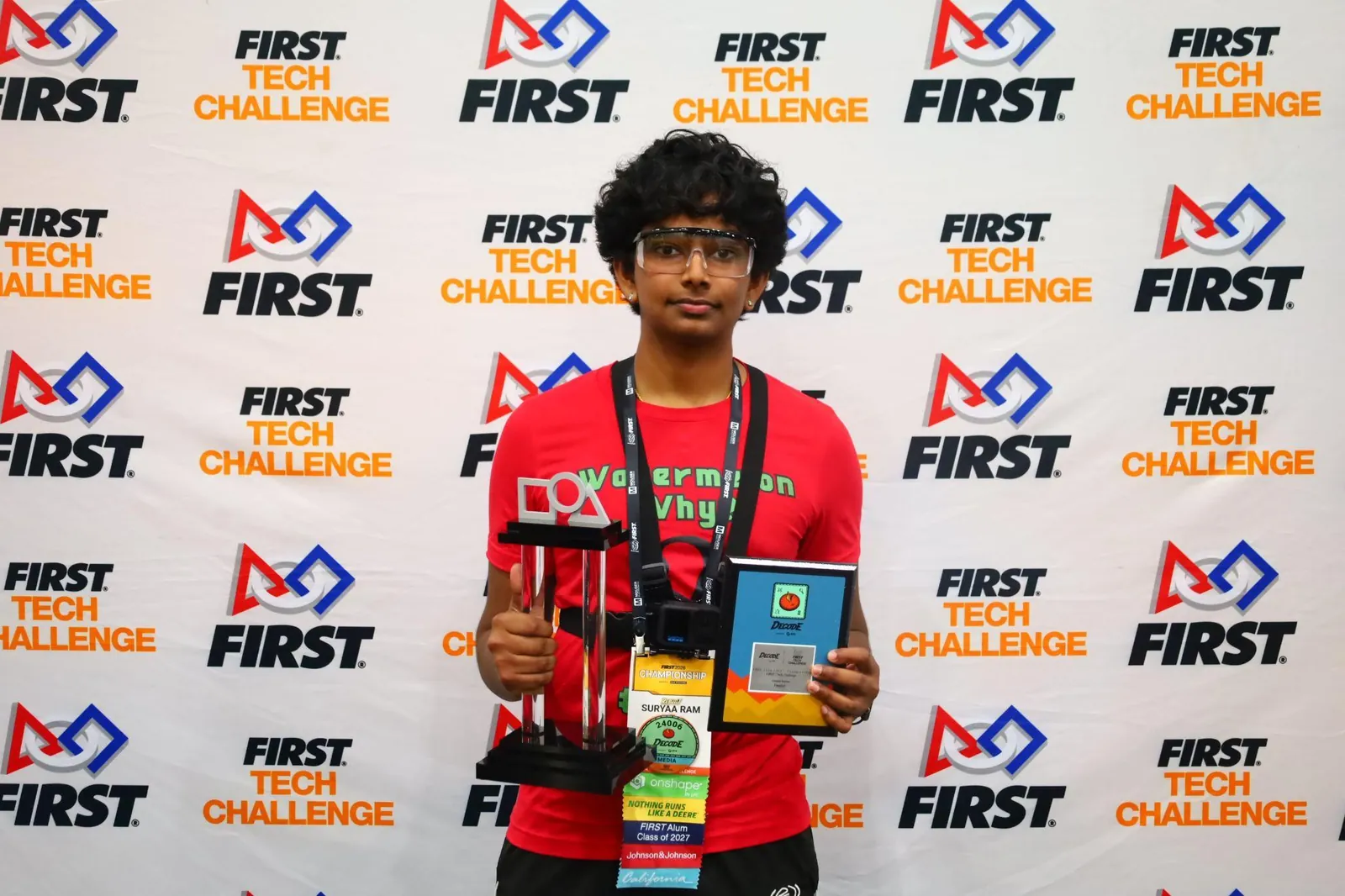
Suryaa holding an award in front of a FIRST Tech Challenge backdrop
Me at FTC Worlds with Team #24006 after finishing as Division Finalists, as alliance captain.

FTC Robots.

KHRONOS, a blue and black FTC robot with carbon fiber plates

KHRONOS

I designed KHRONOS, our final DECODE robot, around a field-centric mecanum drivetrain and a custom carbon fiber frame with CNC-cut plates. It won the Think Award and made the Finalist Alliance at the Palmdale ILT with a season-best 114.4 OPR, then took the Think Award again at the LA Championship.

Season-best OPR
114.4
Autonomous
#276 worldwide
Awards
Think Award ×2
Frame
Carbon fiber, CNC
ORCA, a black FTC robot with a slide outtake

ORCA

I designed ORCA for INTO THE DEEP, with belted outtake slides and a virtual four-bar intake on a custom aluminum frame. It won the Design Award at the Monrovia ILT and ranked 4th at League Meet 0.

Award
Design Award
League Meet 0
4th place
Intake
Virtual four-bar
Frame
Custom aluminum
MELON-PULT, the Team 24006 Watermelon Why robot with a turret shooter

MELON-PULT

As a mentor and robot designer for FTC Team #24006 Watermelon Why, I primarily designed the turret and shooter on their DECODE robot, MELON-PULT. The team went on to become World Championship Division Finalists.

My role
Mentor & robot designer
I designed
Turret & shooter
Result
World Championship Division Finalists
Team
FTC #24006
ROBONEER, a black FTC robot with a purple game ball loaded

ROBONEER

I designed ROBONEER as our first DECODE prototype, a 24-hour build on a custom aluminum frame with a mecanum drivetrain. It ranked 1st at League Meet 0 and 3rd at League Meet 2.

Build time
24 hours
League Meet 0
1st place
League Meet 2
3rd place
Frame
Custom aluminum

Additional Projects.

I designed and built a custom robotic arm with a four-finger articulated gripper, using 3D-printed components and worm-gear-driven joints for precise movement and improved load holding. The arm features a rotating base, multiple independently controlled joints, and a compliant gripping mechanism capable of manipulating objects from different angles. I integrated a REV Control Hub and implemented inverse kinematics to coordinate movement and position the gripper accurately in 3D space. This project allowed me to explore robotic manipulation, mechanical linkages, and motion control.

I built a 3D-printed six-axis motion platform powered by six servo motors, allowing precise control over its tilt, rotation, and positioning. I implemented inverse kinematics and a camera-based tracking system to adjust the platform’s orientation and keep a ball balanced using real-time feedback. Through this project, I explored parallel robotics, motion control, and automated stabilization, combining mechanical design with programming and sensor integration.

I built a custom quasi-direct drive (QDD) actuator featuring a 3D-printed housing, a high-torque brushless motor, and a 9:1 planetary gearbox with helical gears. I integrated an ODrive S1 motor controller with encoder feedback for precise position, velocity, and torque control. This compact actuator combines high torque output with responsive movement, allowing me to explore advanced motor control, gear reduction, and robotic actuation for applications in robotic arms and other robotic systems.

This small-scale model rocket was designed and built by me, combining aerodynamic design, CAD modeling, and precision fabrication. I initially developed and simulated the rocket in OpenRocket, optimizing its stability and flight trajectory before transferring the design into Onshape for detailed 3D modeling. The rocket features a lightweight carbon fiber body tube, a 3D-printed nose cone, and laser-cut wooden fins for aerodynamic stability. During its test launch, the rocket reached an apogee of approximately 2,500 feet and successfully deployed its parachute ejection system for a safe landing and recovery. This project allowed me to apply principles of aerodynamics, propulsion, and flight dynamics to a fully functional rocket.

I designed and built a custom differential swerve drivetrain using 8 NEMA17 stepper motors, with two motors per wheel module controlling propulsion and steering through a differential gear system. I integrated an ESP32 and stepper motor drivers to enable omnidirectional movement, allowing me to control the robot wirelessly through a web-based joystick over Wi-Fi. Through this project, I explored differential gearing, mechanical design, and advanced robotic motion control.

This mousetrap car was designed and built for my AP Physics class to maximize travel distance through efficient energy transfer. My design features an additional pulley that creates a gear-reduction-like effect, reducing pulling force while extending the duration of energy transfer to minimize energy loss. With a lightweight wooden chassis and CD wheels, the car successfully traveled 215 feet, breaking my school’s distance record. This project demonstrates the practical application of torque, mechanical advantage, and energy conservation.

I designed and assembled a custom 5-inch quadcopter drone using four brushless motors, a 4-in-1 electronic speed controller (ESC), an F4 flight controller, and a LiPo battery. I integrated the electronics into a lightweight frame and configured the flight controller for stable, responsive maneuvering. Through this project, I explored aerodynamics, electrical systems, flight stabilization, and multirotor propulsion, gaining hands-on experience in drone design and assembly.

QUADBOT is a custom FIRST LEGO League (FLL) competition robot (for CSK Robot3rs) I designed to maximize functionality while minimizing motor usage. Using a LEGO Technic gear-shifting mechanism, I developed a system that allows four individually selectable output shafts to be controlled using just two motors. This design frees up the remaining hub ports for two drive motors and two color sensors, allowing the robot to perform multiple mission tasks without sacrificing mobility or navigation capabilities. QUADBOT demonstrates how creative mechanical engineering and efficient resource allocation can overcome hardware limitations.

This mousetrap car was designed and built for my AP Physics class with a focus on maximizing acceleration and speed. Unlike traditional wooden designs, I used a lightweight foam chassis and pocketed wheels to reduce mass, while wrapping the wheels in balloon rubber for increased traction and reduced wheel slippage. By optimizing the car’s weight and grip, it traveled 10 feet in just 0.7 seconds, earning first place in my class. This project demonstrates the application of Newton’s laws, friction, and energy transfer to high-speed vehicle design.

I designed and built a custom 3D-printed robotic claw featuring a servo-driven four-bar linkage mechanism that allows both jaws to open and close simultaneously. The design uses interconnected linkages to maintain parallel gripping motion, while rubber-lined jaws provide additional friction for securely holding objects. Through this project, I explored mechanical linkages, CAD modeling, and robotic manipulation, focusing on creating a compact and efficient gripping mechanism.

This small-scale model rocket was designed and built as a proof of concept for my larger carbon fiber rocket. Unlike the final version, this prototype was entirely 3D-printed, including its body, nose cone, and fins, allowing for rapid prototyping and testing. I used this preliminary design to explore aerodynamic stability, structural design, and flight performance before moving on to a larger, more advanced rocket. During its test launch, the prototype successfully reached an apogee of approximately 150 feet. This project served as an important first step in validating my design approach and refining the concepts later incorporated into my carbon fiber rocket.

This balloon-powered car was designed and fully 3D-printed for my Physics Honors class to explore propulsion, aerodynamics, and Newton’s laws of motion. The design features a lightweight chassis, aerodynamic body, and integrated balloon nozzle that converts escaping air into forward thrust. I experimented with wheel alignment, weight distribution, and rolling resistance to improve acceleration and travel distance, applying principles of force, friction, and energy transfer.

Contact me